Essay
DevOps Explained Like a Production Engineer
A no-buzzword, real-world explanation of DevOps — what it actually means, how it differs from Ops, Platform, and SRE, and how the DevOps infinity loop works in production.
Introduction
DevOps is one of the most misunderstood terms in software engineering.
For some, it means “the person who manages AWS.” For others, it’s just CI/CD pipelines. In reality, DevOps is not a role, a tool, or a job title — it is a way of building and running software with production as the first priority.
In this blog, we’ll break DevOps down the way it actually works in real companies:
- What DevOps *really* means (without buzzwords)
- How Dev, Ops, Platform, and SRE differ
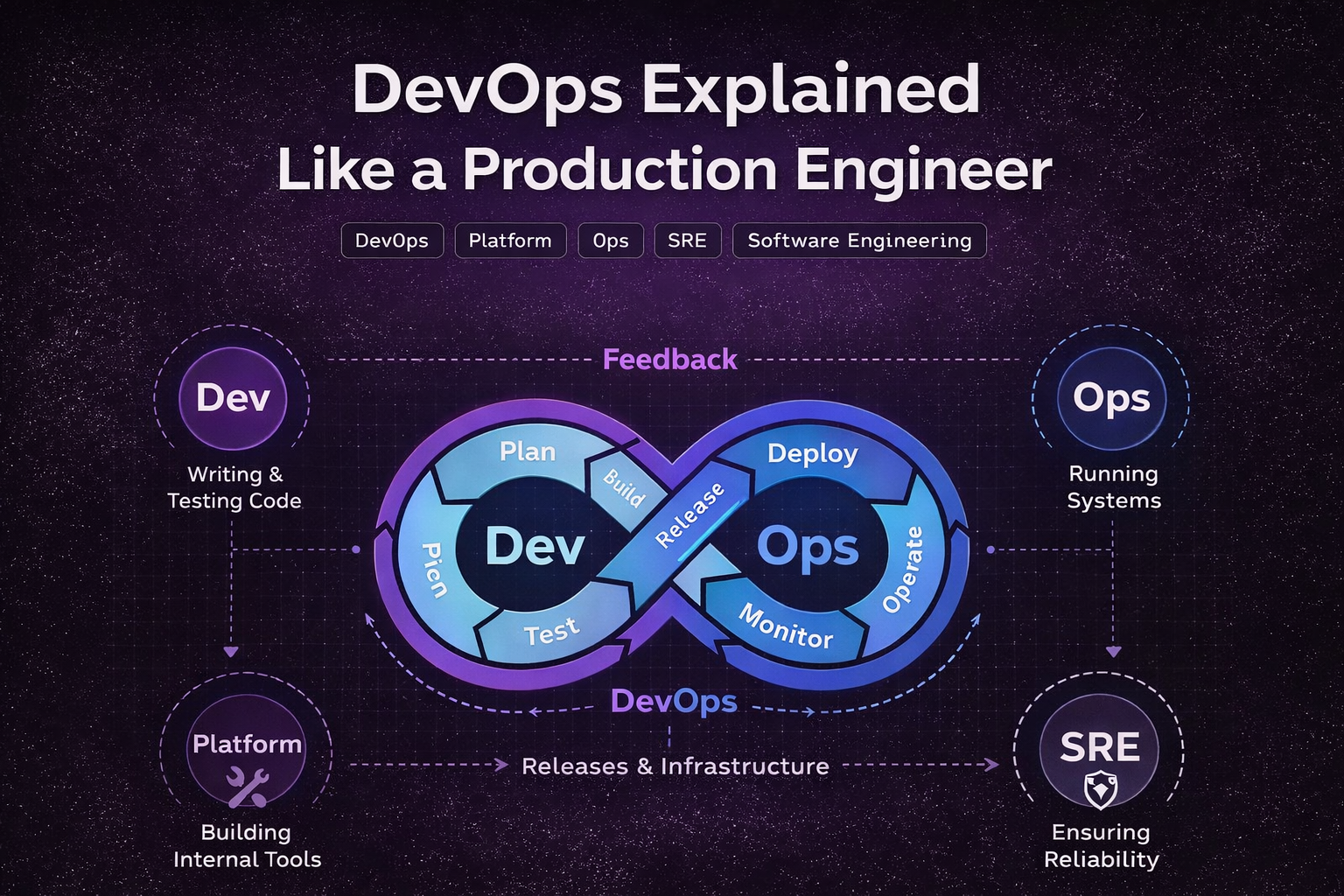
- The DevOps lifecycle explained using the infinity loop
This is DevOps explained like a production engineer, not a slide deck.
What DevOps Really Means (No Buzzwords)
At its core, DevOps is about reducing the gap between writing code and running it safely in production.
It answers three brutal production questions:
- Can we ship changes quickly?
- Can we detect and fix failures fast?
- Can the system survive real-world traffic and mistakes?
DevOps exists because:
- Developers want to move fast
- Production systems punish mistakes
- Manual processes do not scale
So DevOps focuses on:
- Automation over manual work
- Feedback loops over assumptions
- Ownership over handoffs
If something breaks at 2 AM, DevOps is about making sure it’s fixable — fast.
Dev vs Ops vs Platform vs SRE
These roles exist because systems got too complex for a single team to handle everything.
Dev (Application Engineers)
Developers focus on:
- Business logic
- Features and APIs
- Writing code that solves product problems
They care about:
- Speed of development
- Clean abstractions
- Feature correctness
They usually don’t own production reliability end-to-end.
Ops (Traditional Operations)
Operations teams historically focused on:
- Servers and networking
- Manual deployments
- Keeping systems running
They care about:
- Stability
- Uptime
- Infrastructure health
Ops teams were often reactive and separated from developers — which caused slow releases and blame games.
DevOps (The Bridge)
DevOps is not a team — it’s a shared responsibility model.
DevOps principles push teams to:
- Own production behavior
- Automate deployments and infra
- Treat infrastructure as code
- Build systems that are observable and recoverable
A DevOps engineer usually works on:
- CI/CD pipelines
- Infrastructure automation (Terraform, CloudFormation)
- Cloud platforms (AWS, GCP, Azure)
- Monitoring, logging, alerting
- Deployment reliability
They think in terms of systems, not just servers.
Platform Engineering
Platform teams build internal products for engineers.
Their goal:
“Make the right thing the easy thing.”
They provide:
- Golden CI/CD templates
- Standardized Kubernetes platforms
- Internal developer portals
- Self-service infra
Platform teams reduce cognitive load so product teams don’t need to think about infrastructure details.
Platform ≠ DevOps replacement
Platform is DevOps *productized*.
SRE (Site Reliability Engineering)
SRE is DevOps with mathematics and error budgets.
SREs focus on:
- Reliability targets (SLIs, SLOs, SLAs)
- Failure modeling
- Capacity planning
- Incident response and postmortems
They ask:
- How reliable *should* this system be?
- When do we stop shipping and fix stability?
SRE treats reliability as a feature, not an afterthought.
The DevOps Infinity Loop (How It Actually Works)
DevOps is best understood through the infinity loop, because production is never “done”.
Plan → Code → Build → Test
This is the development side:
- Requirements and design
- Writing code
- Automated builds
- Automated tests
Failures here should be cheap and early.
Release → Deploy
This is where DevOps becomes critical:
- Versioned releases
- CI/CD pipelines
- Safe rollouts (blue-green, canary)
- Rollbacks
If deployment requires human bravery, the system is broken.
Operate → Monitor
Now the system faces reality:
- Real users
- Real traffic
- Real failures
Monitoring answers:
- Is the system healthy?
- Is latency acceptable?
- Are errors increasing?
If you can’t see production, you don’t control it.
Feedback → Improve
Incidents feed back into:
- Better alerts
- Safer deployments
- Stronger automation
- Simpler systems
This loop never stops — production always wins.
What DevOps Looks Like in Real Life
In real teams, DevOps means:
- You deploy multiple times a day without fear
- Rollbacks take seconds, not hours
- Infra changes are reviewed like code
- Alerts are meaningful, not noisy
- Incidents lead to learning, not blame
If your system needs explaining to work — it will fail at scale.
Conclusion
DevOps is not:
- A person who knows AWS
- A CI/CD YAML file
- A fancy job title
DevOps is:
- Engineering for failure
- Automating everything that can break
- Designing systems that survive humans
When done right, DevOps disappears — because things just work.
That’s the goal.
Build for production. Everything else is secondary. 🚀